The risk of building on one model path
By Andrew D. Anderson
The risk is not that one AI company is bad.
The risk is that any one company becomes the place where your workflow lives.
If your coding process depends on one provider, one model family, one routing layer, and one product history, you inherit all of that company's downtime, pricing changes, model decisions, and product priorities. When it is up and ahead, everything feels fine. When it goes down, falls behind, changes direction, or starts optimizing for a different customer, your workflow is along for the ride.
That is not a workflow strategy. That is a dependency.
The best model will keep moving
The best coding model today may not be the best coding model next quarter. The best hosted agent may not be the best local agent forever. New CLIs, routers, providers, and deployment patterns will keep showing up because the market is still early.
At some point, local agent models will be strong enough for real everyday work. They will not replace every hosted model overnight, but they will matter. They will be cheaper for some tasks, faster for some workflows, and easier to trust for some codebases.
If your workflow is tied to a vendor-specific app, that transition is harder than it needs to be.
Build around the workspace
hob is designed around the part that should last: the workspace.
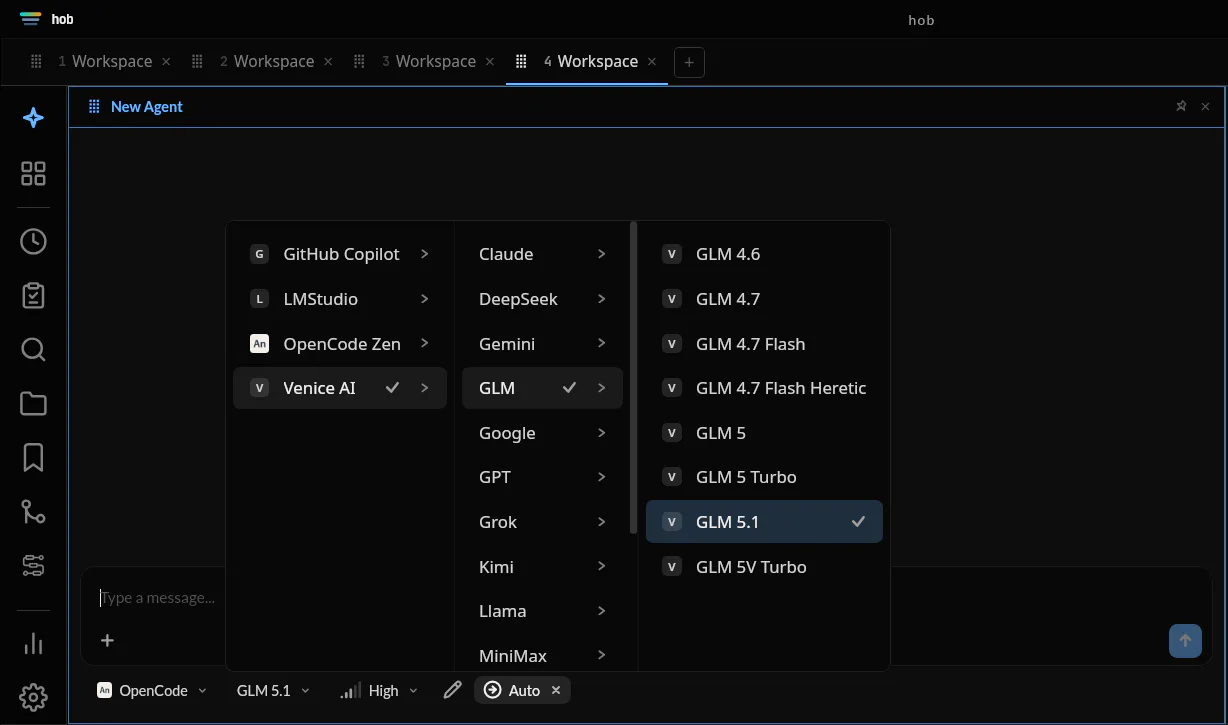
Your agent sessions, terminals, panes, history, project context, and remote access should survive model churn. Claude Code can be right for one job. Codex can be right for another. OpenCode can route somewhere else. A local model may eventually handle work you would not send to a hosted provider.
The model should be a choice inside the workflow, not the foundation underneath it.
That is the point of hob. We are building around optionality because we need it too. Our own companies, projects, terminals, repos, and agent workflows live in the same shifting market our users do.
Optionality rarely feels urgent when the current tool is online, fast, and ahead. It matters later: when the outage hits, when the better model is somewhere else, when the pricing changes, or when the workflow you built starts being impacted by someone else's roadmap.
A workspace for humans and agents
The workspace is not just the GUI. hob is a workspace for humans and agents. That means GUI, CLI, workflow creation, and whatever else the work needs to move cleanly across interfaces, providers, and deployment models.
We are building for that future now, because the developers who understand the risk will want freedom before they are forced to need it.